
Since the 1980s Britain has been in the grip of a confident, ideological ‘neoliberal’ economics that claims that the only route to prosperity is the free market. This has fatally undermined the post-war consensus between left and right that shared a commitment to building a progressive welfare state.
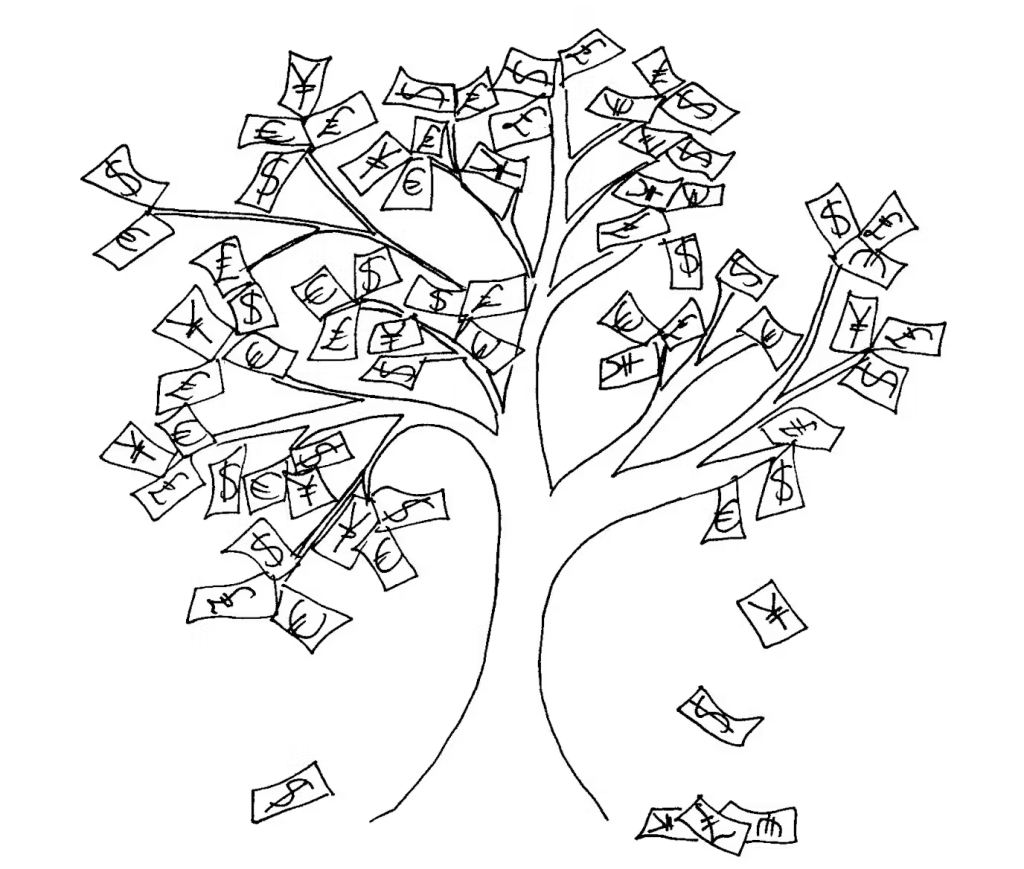
In this ‘free market’ world, proposals for public spending are often met by the politically charged question: ‘Where’s the money to come from? Who’s going to pay? Those advocating new progressive expenditure are accused of believing in ‘magic money trees’. If such an accusation is to be challenged, the myths and assumptions that underlie conventional views about money need to be exposed. Alternative ways of thinking about money have emerged that can open up a route to a more equal and sustainable economy.
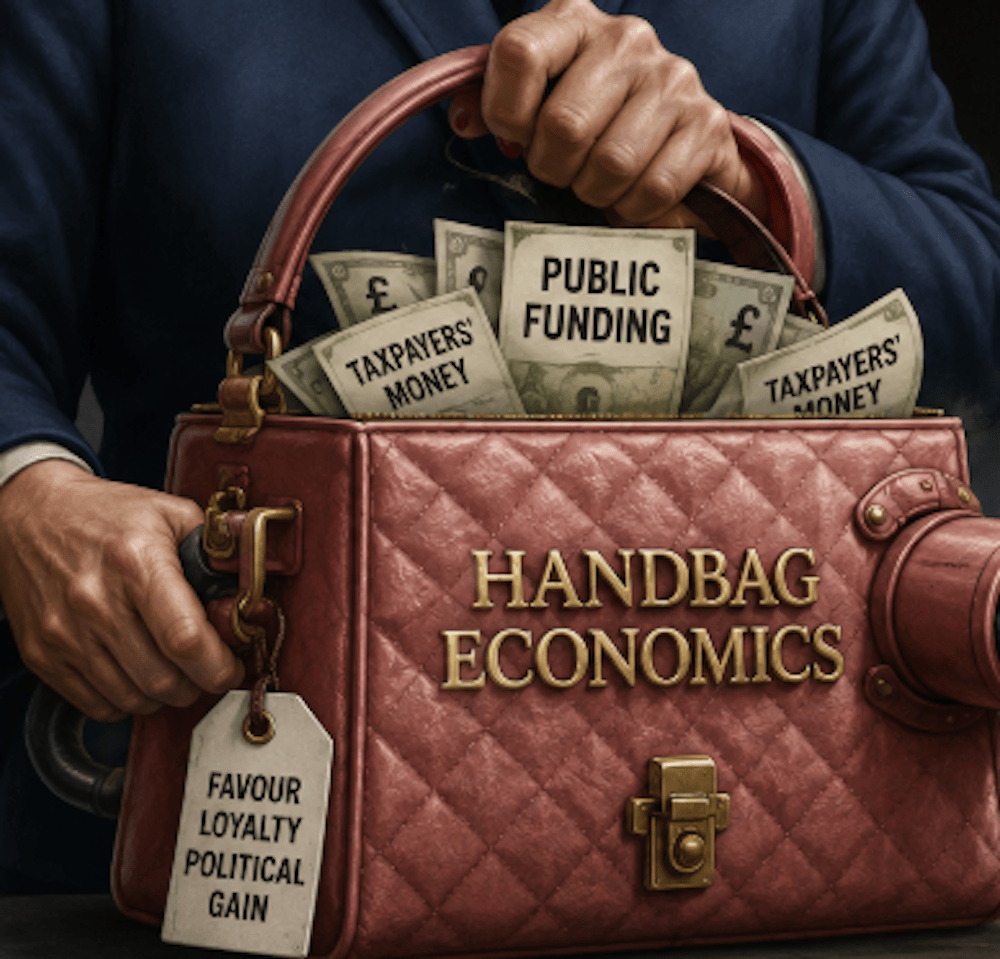
‘Handbag’ economics and the weaponisation of public funding.
A superficially common sense ‘handbag’ economics claims that public spending is a direct drain upon the market. The image presented is public funding being taken from the pockets of hard-pressed (private sector) taxpayers. The public sector is portrayed as being like a household having to live within its means. States must not run deficits, get into debt, or ‘print’ money. Governments must adopt fiscal rules that ‘balance the books’ between tax and spending or face austerity.
Neoliberalism traps progressive policies in a political CATCH 22. If public spending depends on taxing private wealth and the private sector’s ability to create wealth demands low taxation and minimal regulation, the public sector cannot access that wealth, as this would mean increasing taxation… which would undermine wealth creation……
Why focus on money?
Money is the key medium of economic activities in market economies. It is seen as a neutral instrument, which to be most effective, should be a privately administered resource. Only activities valued by money are counted. Neoliberalism claims that if the benefits of the market are to be realised, the entrepreneurial activities of individuals and commercial organisations must not be constrained.
To escape neoliberal orthodoxy it is important to see money in a wider context. Money is as old as human society. It has taken many different forms (sticks, stones, shells, cloths) and its early use was for social purposes (dowries, blood money, tribute). Large scale market money systems only emerged in the past few hundred years. While for mainstream economists, money plays a vital technical role in enabling market efficiency, for critics of capitalism, money is a powerful agent of inequality and exploitation.
The democratisation of money would put economic power in the hands of the people to collectively determine how money is distributed and used. Democratised money would enable the creation of a socially just and ecologically sustainable economy, rather than be a driver of a competitive search for profit. To work towards this end it is necessary to challenge the many myths and misunderstandings about money.
Myths about Money
Myth 1 Money was invented by the market to ease trade by replacing a cumbersome system based on barter, which was inefficient.
This often quoted history of the origin of money is demonstrably false. As the anthropologist David Graeber has pointed out, there is no historical evidence of economic systems based on generalised barter. Rather, barter is something people resort to if a money system breaks down. An example is the period following the collapse of the Soviet Union when factory workers traded their products in the absence of wages.
Myth 2 Money’s original and ideal form was gold and silver, with their own intrinsic value.
This is partly true. Precious metal coinage was invented around 600 BCE – but this long precedes capitalist markets and was mainly used by rulers to fight wars and build prestige projects such as fortifications or religious structures. The weakness of precious metal coinage was that it was too valuable for daily use. It was also subject to debasement, by being mixed with other metals, so the actual value of coins constantly changed.
Today in the UK only a small percentage of currency is held as cash (notes and coin) the rest is held in bank accounts. Future public money may well be digital.
The technological lead has been taken by cryptocurrencies. However the original hope of generating an anonymous, totally private, cryptocurrency to replace today’s publicly authorised money is unlikely to succeed. The main reason is that, like any other public money system, it would need formal guarantee and regulation. This means it could not operate anonymously. The technological enthusiasts who launched the crypto process in 2009 also failed to anticipate the high levels of criminal activities and speculation it would enable.
Myth 3 Money is in short supply.
There is no evidence that money itself is in short supply. There is no fixed pool of money. Even when money was made of scarce, precious metal, trading continued using alternatives such as tally sticks, promissory notes and personal trust. Today, there is no shortage of base metal or paper to create new notes and coin or systems to maintain bank records. Whatever constraints there are on money, it is not literally a shortage of money.
Myth 4 When making loans, banks are merely acting as an intermediary between savers and borrowers
Until very recently it was assumed that bank loans were funded by money deposited in them by savers. It was not until earlier this century that bankers (IMF, Bank of England, FED etc) conceded that bank lending was creating new money, not drawing down existing deposits:
‘the majority of money in the modern economy is created by commercial banks making loans’ …’Rather than banks receiving deposits…and then lending them out, bank lending creates deposits’(Bank of England Quarterly Bulletin 2014.Q1).
However, the realisation that bank lending creates new money has yet to be successfully used to challenge the multiple myths about money.
Myth 5 States do not, or should not, create money.
The neoliberal claim that states do not, or should not, create money is contradictory. If the state does not create money there is no need to instruct it not to. Plainly states can and do create money. This is demonstrated by the huge sums created in times of crisis.
States step in when the privatised money supply fails, most notably following the financial crash of 2007-8. States spent billions bailing out their banks and engaged in long term ‘quantitative easing’ (QE) using electronically generated money to reboot financial markets. The importance of public money creation was made even more clear during the COVID pandemic which saw an extensive publicly funded furlough to maintain people’s jobs during the lockdown. Again, despite this evidence of the ability of states to create vast sums of money, it has done little to undermine monetary orthodoxy.
Public and private money creation: the two circuits of money
To understand modern money it is helpful to see it as a flow, a money supply in constant motion, rather than as individual units. The crucial question is, where does the money come from that fuels the money supply?
There are two sources of new money: state spending and bank lending.
Privatised circuit of money – Bank lending
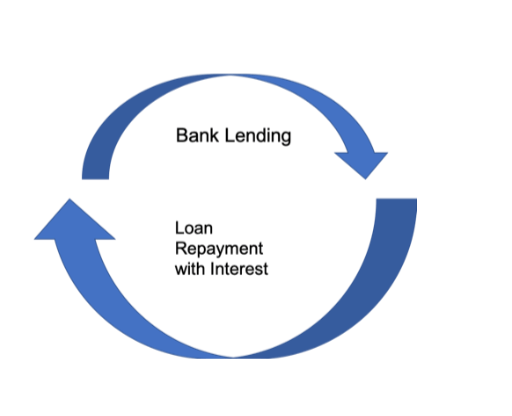
The privatised circuit of money involves a continual flow of debt issue and repayment. Because loans have to be repaid with interest and other charges, the amount of money due to be paid back will be higher than the amount lent, as indicated by the larger bottom arrow.
As the creation of money has become increasingly privatised through bank lending (personal, household, business, government), debt has become the main source of new money.
A money supply based on debt is deeply problematic. A collapse in borrowing can lead to a collapse of the money supply, if people, businesses and institutions can take no more debt, or banks do not see proposed loans as viable. Money disappears as existing debts are repaid and no new ones are taken out.
A money supply based on debt is also socially divisive. Banks only lend to those deemed credit-worthy. Debt-based money turbocharges inequality and financially excludes the poor. While the wealthy use bank lending to enhance their wealth, the poorest are burdened with debt to survive.
Across the globe, debt underpins a substantial portion of world wealth (e.g. private equity, speculative investments, consumer debt, mortgages). It has led to a huge growth in derivative financial speculation that is many times larger than world trade in goods and services. Failure to challenge this privatised money supply has vastly increased the size and power of finance. This will inevitably lead to future crises of even greater magnitude.
As commercial bank lending is licenced by the central bank , this implies there is a guarantee of public backing. The ability to create money has been privatised, while the responsibility for the money created falls on the state via the central banks’ ability to create new public money.
As was found in the financial crisis of 2007-8, the activities of licenced banks and the wider financial sector were so intertwined that central banks had effectively to fund the whole financial sector. It is likely that cryptocurrencies will similarly embed themselves and threaten the downfall of the money supply and the financial sector.
Public circuit of money – State spending
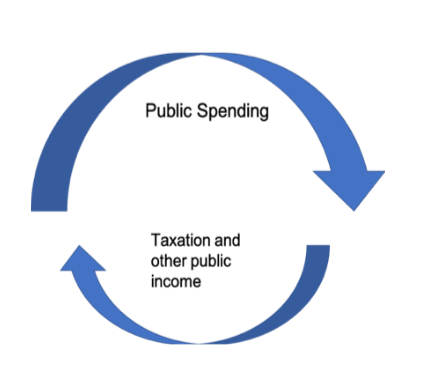
In the diagram above, the arrow representing public spending is larger than the one below because most state budgets are in deficit. They put more money into the flow than they take out. It is clear from state rescue of the private sector that governments can, and do, create new money. Governments are continually engaging in money creation. Public expenditure expands the supply of money, while the payment of taxes reduces it.
A major contribution of one of the radical new perspectives in modern monetary theory is to reverse the orthodox relationship between taxation and state spending. The conventional view assumes that taxation precedes public spending. That public spending is drawn from a tax-funded ‘piggy bank’. Instead the new thinking argues that public spending comes first. Money must be put into circulation before taxes can be taken out.
Whereas debt is the key mechanism creating money supply in the private circuit of money, public spending plus taxation is the key monetary mechanism for the public circuit. The most important difference between market-generated money and state- generated money is that publicly created money can be issued debt free.
Public spending and taxation are two separate exercises. They are only brought together in the process of ‘balancing the books’. The key point is that the relevant balance is not between taxing and spending within the public sector. It is the balance between state money issued and the ability of the market to absorb that money as it enters the flow. Taxation does not raise money, it retrieves money already spent.
This analysis is not a proposal for an alternative structure of state money creation. What the new thinking presents is an alternative analysis of the present system. Recognition of the public circuit of money would enable a new approach to the current money system. It would fundamentally challenge the myths of handbag economics with its constant threat of austerity.
Despite the concrete evidence of the power of the state to create money – and the reliance of the private sector on it – the ideology of neoliberalism has totally captured the political imagination. This is reflected in two areas in particular, state debt and monetary inflation.
Why is deficit a problem?
A deficit describes a situation where a government spends more than it receives in taxes and other payments. The ability of the state to create public money has been obscured by an assumption that any deficit in public spending feeds into overall government debt and must be covered by ‘borrowing ’ from the private sector. Deficits accumulating in the national debt are seen as a ‘burden’ on future generations. As Stephanie Kelton argues, this view of deficits is fundamentally mistaken. Rather than seeing state deficits as a burden, public funding deficits should be seen as a source of ‘free’ money. For the private sector, state borrowing should be seen as a benefit for the pension funds and other investors who need government borrowing as a safe place for their money.
Rather than dire warnings about deficit and the increase in national debt, the more logical approach would be to make a distinction between notional and ‘real’ state borrowing. British government debt falls roughly into three parts : held by the central bank; held by lenders in the UK; held by foreign lenders.
The ‘mountain’ of debt can be immediately reduced by cancelling or re-designating government debt held by the central bank, as it is effectively owed by the state to itself. The second portion of state debt held by domestic bond-holders can always be repaid by issuing new money. That leaves as remaining national debt the portion that is borrowed from foreign sources. This is a particular problem for weaker currencies where states are obliged to hold much more debt in foreign currencies such as the dollar. Countries facing onerous external debt burdens need to be helped by active monetary intervention from global agencies.
Won’t public money creation cause inflation?
Democratisation of the money system will need to challenge neoliberalism’s trump card – that state spending leads to (hyper)inflation. Although both privately created bank-money and publicly created money can be inflationary, the evidence is that while most states run deficits, there is not widespread hyperinflation. As Randall Wray argues, where hyperinflation occurred, money was not a primary cause – it was a response to severe underlying problems in the economy, or other factors such as war.
The evidence from the creation of public money during the pandemic is that, even a vast creation of public money, is not necessarily inflationary. Public spending need not directly impact on prices. However, QE has contributed to the inflation of financial assets as it issued new money directly into financial markets by buying up debts with new electronic money.
It is important therefore not to ignore that monetary inflation is always a possibility. In this context, taxation becomes the key mechanism of monetary management, reducing the money supply when necessary. This could be built into a participatory budget process as in the diagram below.
Managing a participatory budget
Setting a budget is a key focus of governance. Participatory budgeting would see public involvement in discussions about expenditure priorities and on where, when and how tax should be raised. Different kinds of expertise and processes of public involvement will be necessary. In particular, there needs to be a balance between meaningful public participation and monetary management.
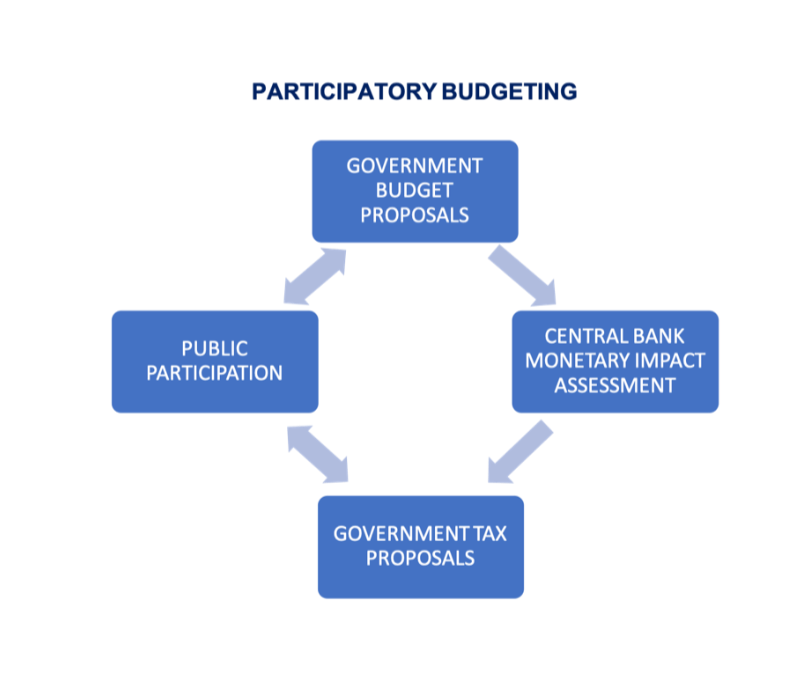
The double headed arrows on the left of the diagram indicate a two- way debate between government and public. Public participation could take a variety of forms, such as standing committees, citizen juries, citizen assemblies, votes, user-provider/producer panels. Debates would be held on the contents of the budget and on the proposed forms of taxation. There would also be a programme of monitoring and evaluation to see that the money was well spent.
The single headed arrows on the right relate to a one-way expert assessment of the monetary impact of the proposed level of expenditure. This would be carried out by the central bank. The Monetary Impact Assessment would be used to calculate the overall level of taxation needed to balance the impact of the proposed public spending on the market. However, the central bank would not be able to challenge the details of the budget or suggest how the taxes would be raised.
Money and the divisions of life
While participatory budgeting can be seen as a radical process, there are much deeper questions that need to be raised about money and its impact. One fundamental issue is the way current money value distorts human life and the life of the planet.
In the table below the list on the left shows aspects of human life generally accorded money value. This is headed by ‘Economic Man’ (who may be female) who is not too young, too old, too sick or troubled. The list on the right is the world of the human body, social life and the environment that ‘Economic Man’ does not acknowledge.
| Money Value | Low/No Money Value |
| ‘Economic Man’ | Women’s work |
| Market Value | Subsistence |
| Personal wealth | Social reciprocity |
| Labour/Intellect | Body, emotions |
| Skills/Tradeable Knowledge | Feelings/Wisdom |
| Able-bodied workers | Sick, needy, old, young |
| Exploitable Resources | Eco-systems, wild nature |
| Unlimited Consumption | Sufficiency |
Money value distorts and divides humanity in a way that is a danger to both people and planet. Real people cannot divide themselves in this way, unlike ‘Economic Man’ who represents only part of the whole reality of human existence and its environment. In particular, the monetised economy does not acknowledge women’s unpaid and underpaid reproductive labour and the ‘free resource’ of nature. It is necessary to address these ‘externalities’ if social justice and ecological sustainability are to be achieved.
Putting ‘women’s work’ social justice and ecological sustainability as core priorities challenges the current market-determined allocation of monetary value.
As the diagram below illustrates, while the market in the top left hand square is monetised and for profit, public and social economies in the bottom left hand square are monetised but not driven by profit. The top right hand square identifies areas where profit is extracted from the ecosystem and unpaid caring and body work labour, but these are not acknowledged as a cost.
The final square identifies areas which are seen as having intrinsic value that cannot be costed, such as a diverse, pristine environment, happiness, good health, peace and caring relationships. Any attempt to exploit these for profit would undermine their intrinsic value.
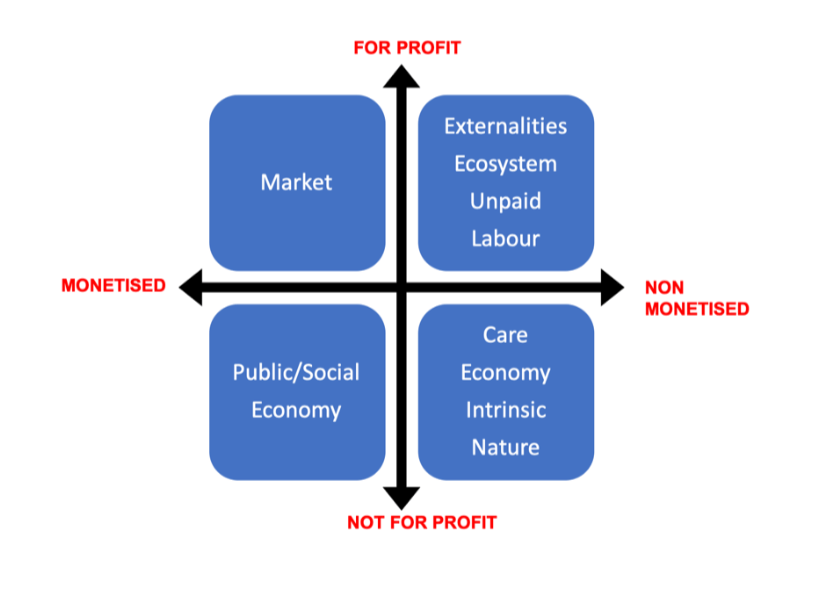
An important aspect of democratising money would be to decide which resources, goods and services should be monetised and/or produced for profit. For example, should the currently exploited, but uncosted, resources of the ecosystem and unpaid labour be monetised by initiatives such as ‘wages for housework’ and an ‘income for nature’. Or should they be recognised and given protection for their intrinsic value? Should the provision of informal care remain unmonetized or be monetised as part of the profit-driven market or become part of the monetised not for profit sector?
These are important questions that need to be addressed if social justice and ecological sustainability are to be achieved. And a key concept to employ, on the route to these, is sufficiency.
Democratising money for sufficiency provisioning
What is needed is a democratisation of money that meets the needs of the 21st century and challenges the privatised and debt-ridden money system. It must reclaim and democratise the power to create money free of debt. Money should be seen as a public resource and banking as a public utility, that takes account of the social and environmental impact of their lending. Public participation in public budgeting would be at the heart of socially just, sustainable provisioning.
While there are obviously issues still to resolve, an alternative to socially and ecologically damaging debt-based and profit-driven capitalism would be sufficiency provisioning – enough for all within the limits of natural resources where no-one has too little or too much.
Unlike production for profit and a money system based on debt, to democratise the creation and circulation of money would address the core needs of human wellbeing and planetary welfare (wellth not wealth). A democratised money system would address the needs of the whole person in all their stages of life. It would address the whole economy of human existence in nature with particular attention to the provisioning needs of the whole body.
At present money divides people into the haves and have not. It is also being syphoned out by billionaires, while the welfare state is being attacked as unaffordable. A sufficiency provisioning economy would allocate money in a way that was socially just and recognised the right to livelihood of all members of the human community and ensured the sustainability of the natural world.
Further Reading
Mellor, Mary (2019) Money: Myths, Truths and Alternatives. Policy Press, Bristol.
Mellor, Mary (2010) The Future of Money: From Financial Crisis to Public Resource. Pluto, London.
References
Graeber, David (2011) Debt: The first 5,000 years Melville House, New York.
Kelton, Stephanie (2020) The Deficit Myth: Modern Monetary Theory and How to Build a Better Economy. John Murray, London.
Wray, L. Randall (2012) Modern Money Theory: A Primer on Macroeconomics for Sovereign Monetary Systems. Palgrave, New York.



Leave a comment