
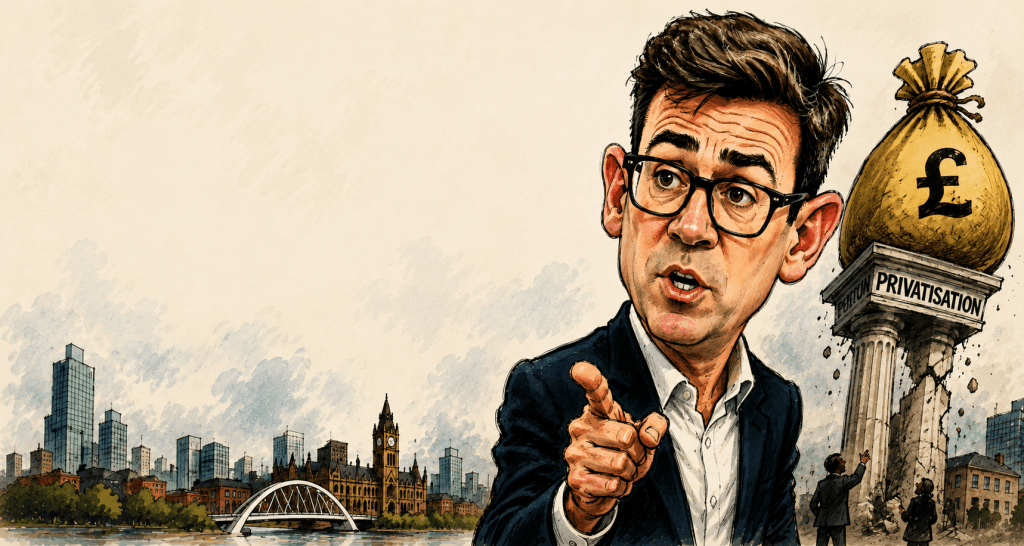
Andy Burnham, sees Britain as having taken a wrong turn in the last 40 years by adopting the neoliberal claim that the only route to prosperity is a free, unrestrained market. In opposition to the privatisation of economic power and centralisation of political power, Burnham offers an alternative ‘new economic model’ based on empowering regional economic development. He envisages public and private long-term investment in key areas, including the green transition.
By Professor Mary Mellor
Burnham’s approach signals a return to the consensus politics of the 1950s-70s when the two main parties shared a commitment to building a substantial public sector and welfare state. Neoliberalism fatally undermined this consensus and set up a conflictual relationship between the market and the state. Using the analogy of the state as household, public funding was weaponised by ‘handbag economics.’
‘Handbag Economics’
In the ‘free market’ world, proposals for public spending are challenged by the politically charged question: ‘Where’s the money to come from? Who’s going to pay? Those advocating progressive expenditure are accused of believing in ‘magic money trees.’ Instead, it is claimed that money is in short supply. Public spending must therefore be limited to what the market can afford. The public sector, like all households, has to live within its means: the money in its handbag.
The public sector is constantly reminded that it is spending ‘taxpayer’s hard-earned money’. As all the money to fund public spending is assumed to be generated by the market, the implication is that it is the private taxpayer whose pockets are being plundered. This sets up a potential conflict between the ’hard-working taxpayer’ and the people receiving welfare payments and the suspicion that money is being wasted. This contention reached a ludicrous extreme when the richest man in the world spent his time trying to cut ‘waste’ in public services.
Neoliberalism has trapped progressive policies in a political CATCH 22…If public spending depends on taxing private wealth and the private sector’s ability to create wealth demands low taxation and minimal regulation, the public sector cannot access that wealth, as this would mean increasing taxation, which would undermine wealth creation…
If Burnham is going to confront neoliberalism he will need to challenge the core of its political strength – the privatisation of money itself. To do this he will need to reclaim money as a public institution. The politics of austerity and the elephant trap of ‘fiscal rules’ must be rejected. The starting point is to expose that the neoliberal view of money is founded on a series of myths.
The myths of money
The main myths about money are that it is an invention of the market and that it is in short supply. Far from being an invention of the market, money is as old as human society. It has taken many different forms (sticks, stones, shells, cloths) and its early use was for social purposes (dowries, blood money, tribute). Market money systems only emerged in the past few hundred years.
The myth that money is in short supply derives from the invention of precious metal coinage around 600 BCE. However this long precedes capitalist markets. Early coinage was used by rulers to fight wars and build prestige projects. The weakness of precious metal coinage was that it was too valuable for daily use. It was also subject to debasement, being mixed with other metals, so the actual value of coins constantly changed. There is no evidence that modern money is in short supply. Even when money was made of scarce, precious metal, trading continued using alternatives such as tally sticks, promissory notes and personal trust.
There is no fixed pool of money, nor a shortage of base metal or paper to create new notes and coin or systems to maintain bank records. Whatever constraints there are on money, it is not a feature of money itself. So, where does money come from? There are two sources of new money: bank lending and state spending.
Privatised creation of money – Bank lending
A key myth of banking is that when making loans, banks are merely acting as an intermediary between savers and borrowers. Until very recently it was assumed that bank loans were funded by money deposited in them by savers. It was not until earlier this century that bankers (IMF, Bank of England, FED etc) conceded that bank lending was creating new money, not drawing down existing deposits: ‘the majority of money in the modern economy is created by commercial banks making loans’ …’Rather than banks receiving deposits…and then lending them out, bank lending creates deposits’(Bank of England Quarterly Bulletin 2014.Q1).
The realisation that bank lending creates new money, rather than recycling existing money, has yet to be successfully used to challenge the privatisation of money. This privatised circuit of money involves a continual flow of debt issue and repayment. Because loans have to be repaid with interest and other charges, the amount of money due to be paid back will be higher than the amount lent. As the creation of money has become increasingly privatised, debt has become the main source of new money.
A money supply based on debt is deeply problematic. A collapse in borrowing can lead to a collapse of the money supply, if people, businesses and institutions can take no more debt, or banks do not see proposed loans as viable. Money disappears as existing debts are repaid and no new ones are taken out.
A money supply based on debt is also socially divisive. Banks only lend to those deemed credit-worthy. Debt-based money turbocharges inequality and financially excludes the poor. While the wealthy use bank lending to enhance their wealth, the poorest are burdened with debt to survive.
Private risk and public rescue
As commercial bank lending is licensed by the central bank, this implies there is a guarantee of public backing. While the ability to create money has been privatised, the responsibility for the money created falls on the state via the central banks’ ability to create new public money. As was found in the financial crisis of 2007-8, the activities of licenced banks and the wider financial sector were so intertwined that central banks had effectively to fund the whole financial sector. It is likely that cryptocurrencies will similarly embed themselves and threaten the downfall of the money supply, necessitating public rescue.
The neoliberal claim that states do not, or should not, create money is contradictory. If the state does not create money, there is no need to instruct it not to. Plainly, states can and do create money. This is demonstrated by the huge sums created in times of crisis. States step in when the privatised money supply fails, most notably following the financial crash of 2007-8 when states spent billions bailing out their banks. The importance of public money creation was made even more obvious during the COVID pandemic, which saw an extensive publicly funded furlough to maintain people’s jobs during the lockdown.
New perspectives on money – the public circuit
New perspectives in money theory reverse the orthodox relationship between taxation and state spending. The conventional view assumes that taxation precedes public spending and that public spending is drawn from a tax-funded ‘piggy bank’. Instead, contemporary monetary theory argues that public spending comes first. Money must be put into circulation before taxes can be taken out. From this perspective, governments are continually engaging in money creation. Public expenditure expands the supply of money, while the payment of taxes reduces it. Taxation does not raise money, it retrieves money already spent.
While debt is the key mechanism creating money supply in the private circuit of money, public spending plus taxation is the key monetary mechanism for the public circuit. The most important difference between market-generated money and state- generated money is that publicly created money can be issued debt free. All government deficits do not need to be covered by borrowing from the private sector. It is also questionable whether any accumulated public debt held by the central bank can be described as borrowed as it is effectively owned by the state to itself. Providing there are no inflationary pressures, modest deficits could contribute to public funding or stimulate demand in key areas.
The new theory of the origin of money is not a proposal for an alternative structure of state money creation. Rather, it is an alternative analysis of the present system. Recognition of the key role of public money generation would enable a new approach to the current money system. It would fundamentally challenge the myths of handbag economics with its constant threat of austerity.
Despite the concrete evidence of the power of the state to create money – and the reliance of the private sector on it – the ideology of neoliberalism has totally captured the political imagination, particularly its trump card – that state-generated money is necessarily inflationary.
Neoliberalism’s trump card
Neoliberalism’s trump card is that state spending leads to (hyper)inflation. Although both privately created bank-money and publicly created money can be inflationary, the evidence is that while most states run deficits, there is not widespread hyperinflation. Detailed research shows that the relatively few examples of hyperinflation arose from complex causes. The evidence from the creation of public money during the pandemic is that, even a vast creation of public money, is not necessarily inflationary. Public spending need not directly impact on prices.
It is important, however, not to ignore that monetary inflation is always a possibility. This is recognised by new thinking which sees taxation as the key mechanism of monetary management, e.g. reducing the money supply when necessary. The key point that current money theorists are making is the balance between state money issued and the ability of the market to absorb that money.
An important mechanism to avoid inflation would be a monetary impact assessment which would calculate the likely impact of the state budget on the market. This would be carried out by an independent professional panel that would advise on the overall level of taxation that would be needed to balance the proposed budget. It would not comment on actual budget proposals or the tax regime.
Reclaiming public money
The key to reclaiming public money is to bring it into the public arena. Democratisation of money would put economic power in the hands of the people to collectively determine how money is distributed and used by both the banks and the state.
A new model of the economy based on public participation to meet the needs of the 21st century would challenge the privatised and debt-ridden money system. It would democratise the power to create money free of debt. Money should be seen as a public resource and banking as a public utility.
Further Reading by Professor Mary Mellor
Mellor, Mary (2019) Money: Myths, Truths and Alternatives. Policy Press, Bristol.
Mellor, Mary (2010) The Future of Money: From Financial Crisis to Public Resource. Pluto, London.






Leave a Reply